share:
Voltage:0.6/1KV
model:YJLV

application:
Power transmission
Building electrical systems
Industrial control and automation
Transportation
advantage:
Aluminum-Conductor Steel-Core Cable: Advanced Aluminum-Conductor Power Cable Solutions
Qinfeng aluminum-conductor power cables are essential components of modern power distribution systems, featuring high conductivity, lightweight design, and cost-effectiveness. As a trusted supplier, we leverage our technical expertise to ensure every installation meets stringent quality standards.
Our aluminum-conductor power cables are designed for both overhead and underground applications, efficiently transmitting power in medium and low voltage systems. Available in a variety of cable types, including all-aluminum conductor (AAC), aluminum-conductor steel-core cable (ACSR), and all-aluminum alloy conductor (AAAC), each carefully designed to meet specific installation requirements while ensuring durability and long-term performance.
Key Features
High Conductivity: Manufactured from high-purity aluminum, our aluminum-conductor power cables offer excellent electrical performance with minimal energy loss.
Lightweight and Cost-Effective: The low weight simplifies handling and installation, reducing overall project costs.
Rugged Insulation: Options such as XLPE and PVC insulation provide heat resistance and protection against environmental stresses. Mechanical Strength: Designed to minimize expansion and contraction, ensuring stability under various conditions. Corrosion-Resistant: Designed to resist oxidation and corrosion, extending the cable's service life.
Applications
Aluminum conductor power cables are widely used in various applications, including:
Overhead transmission and distribution: Suitable for long spans with ACSR variants featuring enhanced tensile strength.
Underground installation: Preferred in medium and low voltage networks due to its corrosion resistance and ease of installation.
Industrial and residential projects: Providing efficient power distribution to factories, commercial buildings, and homes.
Street lighting and renewable energy systems: Ensuring reliable performance of urban infrastructure and renewable energy connections. Comparison: Copper vs. Aluminum Power Cables
In a direct comparison, while copper wire offers superior flexibility and conductivity, our aluminum power cables stand out due to their cost-effectiveness and lightweight design. This "Copper vs. Aluminum Power Cable" comparison highlights that our aluminum-based solutions are ideal for projects where budget and weight are critical.
Copper conductors offer superior electrical performance and flexibility, making them ideal for applications requiring minimal resistance and energy loss. However, copper conductors are expensive. In contrast, aluminum conductors are lighter and more cost-effective, particularly for high-voltage installations, but they offer lower conductivity. Here's a detailed comparison:
Copper Conductors
Advantages:
Superior Conductivity: Copper allows electrical current to flow with minimal resistance and energy loss.
Enhanced Flexibility: Its greater flexibility makes installation easier and more flexible.
Excellent Corrosion Resistance: Copper is generally more corrosion-resistant than aluminum, resulting in a longer service life.
High Tensile Strength: It's strong and less prone to breaking or cracking during installation, especially when working in confined spaces.
Disadvantages:
Higher Cost: Copper's higher price tag makes it a less economical choice for larger projects.
Aluminum Conductors
advantage:
Cost-Effectiveness: Aluminum is significantly less expensive than copper, making it a more economical choice.
Lightweight: Reduced weight simplifies handling and installation, especially for overhead applications.
Good Conductivity: While aluminum's conductivity is only approximately 61% that of copper, it still conducts electricity effectively.
Disadvantages:
Reduced Conductivity: Aluminum's reduced conductivity results in increased resistance and energy loss.
Reduced Flexibility: Aluminum is less ductile than copper, which can complicate some installation scenarios.
Corrosion Sensitivity: Aluminum is more susceptible to corrosion in certain environments, sometimes requiring additional protective measures.
Thermal Expansion: Aluminum expands and contracts more with temperature changes than copper, a factor that must be carefully managed during installation.
Installation Guidelines: For optimal performance, install aluminum conductor power cables at temperatures not exceeding 20°C. In environments below 0°C, preheat the cable before installation. Ensure a bend radius of at least 8 times the cable diameter and perform a 3.5kV DC voltage test for 15 minutes after installation to verify the cable's integrity and safety. Aluminum conductor power cables offer high conductivity, durability, and a cost-effective design, providing superior performance for a wide range of power distribution applications.
Experience the unparalleled quality and performance of aluminum conductor power cables with VOLTIS' industry-leading, high-efficiency overhead and underground system solutions.
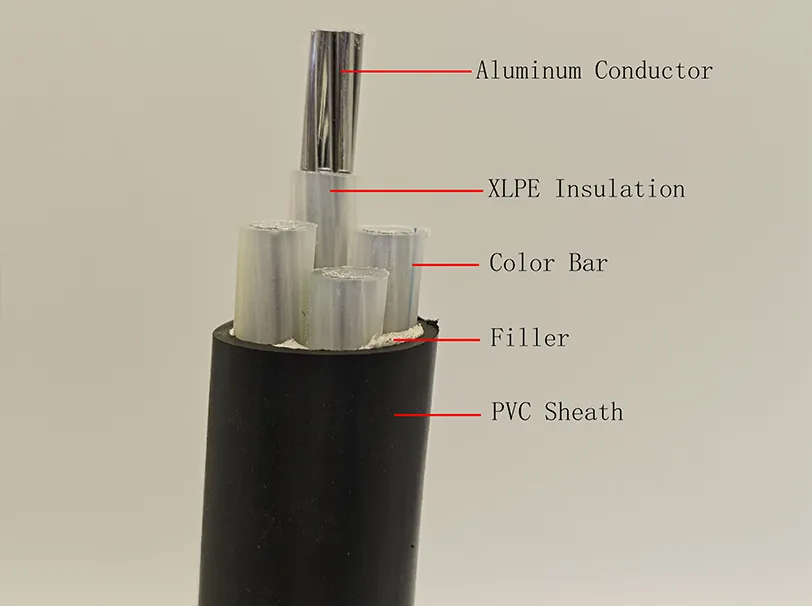
Conductor: Oxygen-free aluminum
Insulation: Cross-linked polyethylene
Insulation color: Natural or custom
Filling material: Non-hygroscopic
Outer jacket: PVC/PE
Jacket color: Black
Physical properties:
Conductor maximum operating temperature:
70°C (PVC insulation), 90°C (XLPE insulation)
Minimum operating temperature:
-5°C (PVC or LSZH jacket), -20°C (PE jacket)
Short-circuit temperature (up to 5 seconds):
140°C-160°C (PVC insulation), 250°C (XLPE insulation)